Testimonials

Testimonials

We are delighted to announce our Station House Vets equine ambassadors for 2022.

Here is an introduction from Grace & Jess. We will be following them throughout 2022 on social media and providing updates as they happen!

Grace Smith is our Young Equine Ambassador

“My name is Grace Smith but known to many as Binky! I am 12 years old and attend Ryedale school and I live on a farm in Nawton.
 
I have been riding since before I could walk! My first pony was Donna who at the age of 30 Is still with us today making us laugh! The pony I have now is Boysie (MOCHACCINO); he is 19 years young – a 14hh dun and white turbo cob!! He is very cheeky at times!
 
I have had Boysie for 4 years now and in those four years we have gone from doing intro dressage to working at elementary tests, we have competed in the British Riding Clubs dressage to music championships placing 2nd last year and the Riding Club Nationals again coming 2nd.
 
Last year we also attended BD Youth camp at Bishop Burton and hope to progress and train towards gaining a place on a BD team.
 
Already in 2022 we have qualified for BD Combined Training Championships and also BD Petplan Area Festivals along with this I would love do some more eventing and perhaps qualify for the 80 championships which are to be held at Bramham.. How exciting would that be!!
 
I am very excited to be the 2022 youth ambassador for Station House vets because I compete and train regularly and will love sharing the ups and downs of mine and Boysies journey with you and your Station House Vets followers!”
Jess Johnson is our Equine Ambassador for 2022
“Hi I’m Jess Johnson, 25 from Terrington. I run my own business in human sports therapy and I live on my family’s farm with my horses.
 
I have been lucky enough to have grown up around horses with my parents having them and I knew it wasn’t just a “phase”. I was addicted to them; I did pony club from a young age and here I found my passion for eventing!
 
At home in the Howardian Hills the hacking is beautiful and I regularly train with Lucinda Atkinson and Nicky Lyons.
 
I evented to 2* last season and hope to do the same and higher this season with my eventers. I compete in BE, FEI and for Malton Riding club, and in the winter I enjoy my trail hunting.
 
I also have a young horse that will start his education this season at local events this season hoping to event him later on.
 
I’m delighted to be part of the Station House Vets Team of equine ambassadors and look forward to sharing our journey with you and your followers.”
We are so happy to have Grace & Jess on board and look forward to following their journeys throughout 2022.  Good luck to you both for the upcoming season.

Registration is now closed as we are up to capacity for the event – but if you wish to be on a waiting list, please continue to register and we will contact you to confirm.

On Thursday 7 April 2022, we are holding ‘An evening with Station House Vets’ presenting and discussing lameness treatment options in horses.

The evening will focus predominantly on stem cell treatment, and will also feature ultrasound and shockwave therapy.

We will be providing a light supper as part of the evening, which is kindly sponsored by Boehringer.

We are asking for a £5 donation on the evening – you will be entered into a raffle which is sponsored by Hills Pet Nutrition and all funds raised from the raffle will go to our Ukraine appeal, to help pets in Ukraine.

Starting at 6.30pm for around an hour and a half, we hope you can join us!

Don’t miss out – Book your place now.

Enter your details and dietary requirements by clicking on “Register now” above.


This week is equine flu awareness week.

What is equine flu? 
Equine flu is a highly contagious viral respiratory disease which can spread rapidly among unvaccinated horses.
What are the symptoms of equine flu?
– a high temperature (over 38. 5 degrees C)
– a dry, harsh cough
– a clear, watery nasal discharge
– loss of appetite
– lethargy
How is equine flu spread?
It can be spread through direct contact with another horse, by air and also indirectly via people, equipment, tack etc.
Help protect and prevent is better than cure!
Vaccination is the best thing you can do for your horse and for the equine population in general.
When should I vaccinate?

1st vaccination should be given around 5-6 months old
2nd vaccination to be given around 4-6 weeks later
3rd vaccination to be given 5-6 months later
Booster vaccinations must be given within 365 days of the 1st vaccination to avoid a re-start

What if my horse competes?
If your horse competes you will need to check with the relevant authority as some bodies (FEI, BD, BE, BS) require more regular 6 monthly boosters.

Visit @KeepingHorsesHealthy to find out more
 

#EFAW2022 #equinefluawarenessweek 

🐴 To worm or not to worm? 🐴
 
Let us take the hassle out of worrying about worming. Join our Equine Worm Egg Count Plan today.
 
We are launching our equine worm egg count plans – just in time for the main grazing season : March to October.
 
Why are worm egg counts important?
It is no longer appropriate to just worm horses & ponies on a regular basis without testing.
 
Each time a wormer is used, the surviving worms are resistant to the drug used. The more you use wormers the more chance there is for resistance to develop in the worm population.
 
Worm egg counts are important as they confirm whether a wormer is required or not, depending on the level of the egg burden at the time.
 
When and how often do I need to do worm egg counts?
The optimum time to perform is in the main grazing season between early March and late October.
 
The benefits of being on a worm egg plan:
discounted rates rather than paying for testing and treatment individually
✅ annual one-off charge
✅ regular checks determine if your horse needs treating for worms or not
✅ reminders sent out by us, so you don’t have to remember when your next sample is due
✅ peace of mind you are not under or over worming your horse
✅ do something positive for your horse, your pasture and the planet! 💚
 
Give the team a call now on 01653 618303 to get started on your worm egg count plan and let us take the hassle out of worrying about worming!
 
Visit to find out more – all the questions you’d ask are answered here!
 
Or you can view a full pdf flier on equine worming egg counts :

What’s in a dogs name?  We take a look at a range of common dog breeds

During the peak of the pandemic whilst home schooling my two primary school age boys I learned a good word- portmanteau!

This is when a word is made by blending the sounds and combining the meaning of two others. Common examples we all know are brunch (breakfast and lunch) or ginormous (giant and enormous).

I quickly realised the dog world is full of such examples these days. Not a day goes by without me seeing a Cockerpoo, Cavapoo or a Labradoodle.

When I graduated in 2004 – I only saw a pedigree or a proper cross breed – a Heinz 57, a mutt! (I have one of these myself!) But some time later, maybe around 2010, we started to see more and more Labradoodles (Labrador Retriever x Poodle).

The two way cross had been around for some time – first reported in America in 1955, but suddenly hit real popularity, considered a good choice for people with dog fur allergies, also nice natured and attractive dogs and with the theory that crossing the two breeds creates ‘hybrid vigour’ and reduces the likelihood of inherited health defects.

Then came the rise of the Cockerpoo (Cocker Spaniel x Poodle) also attractive, fun, nice natured dogs but smaller than the Labradoodle and probably an easier family pet/companion dog for many due to the smaller size- with an average weight of 12-15kg compared to the 30kg average weight of the Labradoodle.

The popularity of these two way cross breeds, sometimes called designer crosses, is now huge in the UK and can still keep us vets on our toes when we see a new two way crossbreed- trying to work out what it could be.

Here are a few we see:
Jug- Jack Russell Terrier x Pug
Pomski- Pomeranian x Husky
Dalmador- Dalmatian x Labrador
Cavapoo- Cavalier King Charles Spaniel x Poodle
Golden Doodle- Golden Retriever x Poodle
Cavachon- Cavalier King Charles Spaniel x Bichon Frise

Any guesses for Puggle or Shorkie is made up of?!

There are many more lovely ‘designer cross breeds’ out there and they all make great pets- family friendly and fun.

If you are thinking of getting a dog and would like advice our nurse team are always keen to talk you through choosing the right addition for you family. Just give us a call or drop us an email.

Photo of nurse Ellie Kifts Yorkshire bred ‘designer cross breed’ Douglas the Australian Labradoodle- what a handsome fellow he is!

Written by Vicky Williams, BVM&S  MRCVS

World Spay Day

🐕 🐈 🐴
Today is #WorldSpayDay highlighting the importance of getting your pets neutered, spayed, or castrated.
 
Although referred to in different ways, they all essentially mean the same thing. Spay is typically used to refer to females, castrate for males, and neutering as a general term.
 
The process is a simple surgical procedure administrated by a vet that removes the reproductive organs and declares a pet/horse to be sterile.
 
This has several benefits for both you and your pets & horses. It is a relatively short procedure (always done under general anaesthetic) with a brief recovery period afterwards, but it has lifelong benefits.
 
Pets & horses will live a longer and healthier life through various health benefits of the procedure, as well as you doing your part to prevent overpopulation.
 
If you wish to chat to the team about spaying, neutering or castrating your small pets or horses, give the team a call on 01653 618303.

Meet Junior, our vet Amelia’s horse.

When Amelia purchased Junior she knew he had kissing spine. She x-rayed him as a 4 year old and again at 7 years old. The second x-rays showed some improvement. 

As a 7 year old he was given steroid injections in his back which gave him about a 10% improvement.

Junior had an accident cross country and started to lose confidence.

His main symptoms (‘bad’ behaviour) were predominantly on the lunge. He would buck when going into canter, change behind in canter alongside lots of tail swishing.

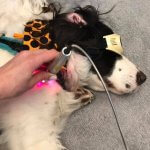
Last year Amelia started an acupuncture course of 6 sessions once per week. Junior has since moved onto a maintenance programme which progressed from having acupuncture every fortnight, then every month and he now has acupuncture every 6 weeks on average, or as and when the ‘bad’ behaviour on the lunge returns.

Junior has a varied programme of work from lungeing, schooling, hacking, lessons and he also competes.

His regular schooling work has a strict regime:

  • a good groom to help promote blood circulation
  • lunge/in-hand work before being ridden which will start with 10 minutes in walk followed by 10 minutes in walk & canter with regular breaks
  • 20-30 minute ridden schooling work

This regime is only for Junior’s schooling work which might be once or twice per week.  However, this means that Amelia can keep a close eye on him and when the ‘bad’ behaviour starts again it’s time to book him in for his next acupuncture session.

Junior is doing really well and he’s loving his jumping, thanks to Amelia’s strict routine and his regular acupuncture sessions.

Find out more about the benefits of acupuncture to your horse – click here!
Call the practice on 01653 618303 to discuss acupuncture for your horse with our team.

Alice and Big B tell us their story about how they have managed to overcome big B’s fear of needles, working closely with Catriona and the team at Station House Vets.

My horse Big B has long had a nervous disposition. Visits from the vet, farrier and other equine professionals have been a trigger for her anxiety in the past, in fact any change to her daily routine can often be a cause for her to get upset.

Being nervous, for years Big B required sedation for clipping and dental work, all of which along with her routine vaccinations, involved one of her biggest fears – needles!

I realised I was going to have to do something about this fear when about 6 years ago my previous vet was trying to sedate her for clipping and she knocked him across the stable into the wall with just her head – she is over 18hh and being a shire cross, she is extremely powerful and although not nasty when she is panicking you don’t want to be in the wrong place at the wrong time as her spatial awareness goes out the window. The next time the vet returned to see her he was wearing his hard hat and body protector and I knew if I didn’t address it properly it was only going to be a matter of time before me or the vet got hurt.

The first thing I decided to do was to create a routine for B, for anything to do with needles so she knew what to expect and could feel as prepared as possible. I knew she needed to be able to go out as normal on a morning and so I would arrange a time for the vet to come mid morning so she could have some time in her field before hand then come in to her stable in peace. She loves to be scratched and it always calms her down and so basically I would stand and scratch her for about 10 mins before the vet came helping her to relax. Importantly I also needed to remain calm, if I were to get tense then B would immediately know something was wrong and would start to worry, so I found singing or talking to her while waiting helped! I would tell my vet to come to the stable so she didn’t need me to leave her and he would walk in not speaking and just jab her with no faffing or wafting the needle around before hand. This improved the situation, but we would still find she was not totally settled and sometimes she would still jump or shoot up against the wall.

A big turning point was when I took B for a week long holiday where we tried our hand at positive reinforcement training. B absolutely loved this. She is very intelligent, and encouraging her to investigate scary things for herself with no pressure and the option to stop if she wanted really improved our relationship and confidence in each other.

Shortly after this I also moved vets to Station House Vets, Catriona became B’s main vet and this is where the improvement really started. I explained B’s nervousness to Catriona and the big difference was that she also took time to create a relationship with B so that B also began to trust her, not just me. When visiting our yard for other horses, sometimes Catriona would pop and see B in her stable while she was passing, not for a veterinary reason but just to say a quick hello and give her a treat so that she wasn’t always seeing her for something unpleasant.

B is also a frequent visitor to Station House so this has helped! Catriona is very patient and never rushes with B or raises her voice, she talks to her quietly and calmly and after any injection always gives her a treat and a fuss. This year we have been able to jab her just stood outside while chatting – she has come a very long way. It also meant that when she needed to go to Rainbow for lameness investigations, nerve blocks could be carried out with less stress than it would have previously involved, Catriona took the time to speak to the vets at Rainbow and let them know about B’s worry with needles so they too could be prepared.

Working on this also gave me the confidence to tackle other things that B found frightening, I no longer need sedation to clip her, she can be hot shod without panicking and I can worm her without a headcollar. It didn’t happen over night; it was years of patience, routine and reward but the improvement from 8 years ago is huge and I am very grateful to Catriona and the other vets at Station House who have since also had to jab B and followed the same routine to create the calmest environment for B and the safest environment for me and for them!

National pet dental health month

 
To celebrate pet dental health month we are offering free dental checks* to the end of February for all our clients – great & small!
 
🐕 🐈 🐇 🐁
Our small animal clients are invited to book in with our vet nursing team for a pet dental health check.
 
🐴
And for our equine clients we are offering a free dental check – alongside an already planned appointment or visit; just let us know in advance if we’re coming out to you so we can ensure our equine veterinary team have their dental equipment with them.
 
The small animal dental checks are ideal for clients with young dogs and cats as we can show you how to brush their teeth. It is important all pets’ teeth get regular attention but those who are middle aged and senior dogs should receive special attention.
 
Like us our pets teeth health deteriorates with age, so it’s important we are doing everything for them. At the small animal dental checks you will also receive a dental information pack.
 
While visiting the practice for your checks, we have some a range of dental health products you can buy – including tooth brushing kits and other products to help with your pets dental health.
 
Learn more about dental health on our website:
Small animals :
Horses :
 
Call the practice on 01653 618303 to book your free dental small animal check or free equine dental health check now.
* free dental health check. Any dental work over and above the check will need to be paid for.