Testimonials

Testimonials

Meet Junior, our vet Amelia’s horse.
When Amelia purchased Junior she knew he had kissing spine. She x-rayed him as a 4 year old and again at 7 years old. The second x-rays showed some improvement.
As a 7 year old he was given steroid injections in his back which gave him about a 10% improvement.
His main symptoms (‘bad’ behaviour) were predominantly on the lunge. He would buck when going into canter, change behind in canter alongside lots of tail swishing.
Junior has a varied programme of work from lungeing, schooling, hacking, lessons and he also competes.
His regular schooling work has a strict regime:
- a good groom to help promote blood circulation
- lunge/in-hand work before being ridden which will start with 10 minutes in walk followed by 10 minutes in walk & canter with regular breaks
- 20-30 minute ridden schooling work
This regime is only for Junior’s schooling work which might be once or twice per week. However, this means that Amelia can keep a close eye on him and when the ‘bad’ behaviour starts again it’s time to book him in for his next acupuncture session.
Junior is doing really well and he’s loving his jumping, thanks to Amelia’s strict routine and his regular acupuncture sessions.


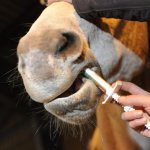
Alice and Big B tell us their story about how they have managed to overcome big B’s fear of needles, working closely with Catriona and the team at Station House Vets.
My horse Big B has long had a nervous disposition. Visits from the vet, farrier and other equine professionals have been a trigger for her anxiety in the past, in fact any change to her daily routine can often be a cause for her to get upset.
Being nervous, for years Big B required sedation for clipping and dental work, all of which along with her routine vaccinations, involved one of her biggest fears – needles!
I realised I was going to have to do something about this fear when about 6 years ago my previous vet was trying to sedate her for clipping and she knocked him across the stable into the wall with just her head – she is over 18hh and being a shire cross, she is extremely powerful and although not nasty when she is panicking you don’t want to be in the wrong place at the wrong time as her spatial awareness goes out the window. The next time the vet returned to see her he was wearing his hard hat and body protector and I knew if I didn’t address it properly it was only going to be a matter of time before me or the vet got hurt.
The first thing I decided to do was to create a routine for B, for anything to do with needles so she knew what to expect and could feel as prepared as possible. I knew she needed to be able to go out as normal on a morning and so I would arrange a time for the vet to come mid morning so she could have some time in her field before hand then come in to her stable in peace. She loves to be scratched and it always calms her down and so basically I would stand and scratch her for about 10 mins before the vet came helping her to relax. Importantly I also needed to remain calm, if I were to get tense then B would immediately know something was wrong and would start to worry, so I found singing or talking to her while waiting helped! I would tell my vet to come to the stable so she didn’t need me to leave her and he would walk in not speaking and just jab her with no faffing or wafting the needle around before hand. This improved the situation, but we would still find she was not totally settled and sometimes she would still jump or shoot up against the wall.
A big turning point was when I took B for a week long holiday where we tried our hand at positive reinforcement training. B absolutely loved this. She is very intelligent, and encouraging her to investigate scary things for herself with no pressure and the option to stop if she wanted really improved our relationship and confidence in each other.
Shortly after this I also moved vets to Station House Vets, Catriona became B’s main vet and this is where the improvement really started. I explained B’s nervousness to Catriona and the big difference was that she also took time to create a relationship with B so that B also began to trust her, not just me. When visiting our yard for other horses, sometimes Catriona would pop and see B in her stable while she was passing, not for a veterinary reason but just to say a quick hello and give her a treat so that she wasn’t always seeing her for something unpleasant.
B is also a frequent visitor to Station House so this has helped! Catriona is very patient and never rushes with B or raises her voice, she talks to her quietly and calmly and after any injection always gives her a treat and a fuss. This year we have been able to jab her just stood outside while chatting – she has come a very long way. It also meant that when she needed to go to Rainbow for lameness investigations, nerve blocks could be carried out with less stress than it would have previously involved, Catriona took the time to speak to the vets at Rainbow and let them know about B’s worry with needles so they too could be prepared.
Working on this also gave me the confidence to tackle other things that B found frightening, I no longer need sedation to clip her, she can be hot shod without panicking and I can worm her without a headcollar. It didn’t happen over night; it was years of patience, routine and reward but the improvement from 8 years ago is huge and I am very grateful to Catriona and the other vets at Station House who have since also had to jab B and followed the same routine to create the calmest environment for B and the safest environment for me and for them!

National pet dental health month

Meet Rosa and Elspeth.
I brought Rosa our welsh section D 15 year old mare into see Amelia for a lameness work up after a period of time off and treatment didn’t seem to be doing the trick for her. She was still refusing to jump and wasn’t happy in her work.

Its time to pre-order sweet itch vaccines for your afflicted ponies & horses as we have to import them from abroad for you. This is only available to clients who are registered with us.
So it’s important for us to know who needs them well in advance.
If you have an affected horse or pony, you know that the signs usually develop when the culicoides midge become active with the warmer weather, ie March onwards.
The vaccine is not 100% effective with 1/3 of animals not responding, another 1/3 are much improved and the final 1/3 are perfect. We can’t tell you which will be successful.
For sweet itch we do two injections two weeks apart, ether at the practice or we can arrange a visit to you. The cost of the vaccine is £75 each injection (which includes the import cost and associated admin), plus the cost of the visit if needed.
Find out more about sweet itch treatment and management here.
To pre-order please contact us now at:
Email – prescriptions@stationhousevets.co.uk
Tel – 01653 618303

In light of the latest COVID guidance issued, we are updating our COVID procedures.
As of today, Thursday 27 January 2022, we ask that clients continue to wear face coverings/masks at all times within our premises.
Our team continue to wear their face masks at work.
We won’t be allowing you (our clients) back in to the consult rooms just yet but you are welcome in the waiting room and reception area; we just ask that you do continue to wear a mask if you can.
We will review these protocols again at the end of February 2022 and provide a further update.
We want to continue to do whatever we can to protect our team as well as their families and loved ones, and ensure we can continue to provide the ongoing care and support for your pets. We also have a responsibility to continue to protect you – our wonderful clients.
Thank you once again for your patience and support.
Best wishes, The Station House Vets Team
Email: admin@stationhousevets.co.uk

We are looking for a 2022 Station House Vets Equine Young Ambassador.
We’d love entries from any of our young clients who are of Pony Club age so that we can follow your journey with your pony/horse throughout the year. We will provide you with some branded goodies and discounts in return for you providing us with regular updates and photo’s on how you and your four legged friend are doing throughout the year, for our social media and our blog.
If you’d like to be considered for this exciting new position/role/venture, please email us a photo and a short synopsis of you and your pony/horse and why you think you should be our Station House Vet Young Ambassador.
Entries close Monday 31st January. Emails to be sent to rachelreedeeles@outlook.com

We run regular equine gastroscopy clinics and our next clinic at the practice is on Friday 4th February 2022.
With up to 100% of performance horses, 59% of leisure horses and more than 50% of foals suffering from gastric lesions, we offer regular gastroscopy clinics so you can get your horse checked out if you have any concerns.
It is preferable for your horse to come in the afternoon before and be stabled with us ready for the clinic the next day. At these clinics we offer a discounted price which includes sedation and overnight stabling.
Contact the practice now on 01653 618303 to book in for the next equine gastroscopy clinic on 4th February; just two spaces left on this clinic.